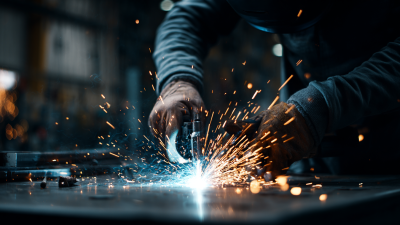
So, how do you pick the right flux core welding wire in 2026? Honestly, it starts with the joint—not the catalog. You need to match the wire to your base-metal thickness, welding position, shielding method, and the load it'll actually have to handle. A wire that runs great on a 10-millimeter structural plate can feel like a totally different animal on thin sheet. And before you start comparing prices, check the AWS A5.20 or ISO 17632 classifications.
And honestly, the industry numbers back up being careful here. The U.S. Bureau of Labor Statistics still lists welding as one of the big skilled-trade occupations, with thousands of openings every year just from replacement demand. The American Welding Society has pointed this out again and again, too: there's a real workforce shortage, and shops need welding processes they can actually rely on to be reliable and productive. Meanwhile, Grand View Research says the global welding equipment market keeps growing, which makes sense when you consider how much more we're seeing mechanized setups and flux-cored systems in use. Those reports might show demand, sure—but they won’t pick the right spool for your job. The little things matter here. E71T-1C/M can be a good fit for clean structural work when you’re using mixed shielding gases, while E71T-11 is handy when external gas just isn’t practical. And always check polarity, amperage range, impact requirements, and position limits. Once you open a spool, keep it in a dry cabinet. Humidity has a sneaky way of adding porosity, spatter, and extra rework. A smooth bead? That doesn’t prove much by itself.
In real shop trials, the best wire usually ends up being the one that cuts down cleanup without hurting penetration. That said, test coupons are worth paying more attention to than any marketing hype. Even a quick trial can show you things like arc instability, slag that doesn't come off cleanly, or way too much smoke. Some recommendations are never going to be perfect, because operator technique, machine calibration, and joint fit-up all shift the outcome. And that uncertainty? It should be measured, not swept under the rug.
Flux core welding wire contains a powdered flux inside a tubular electrode. It supports welding outdoors, where wind can disturb shielding gas. It also handles mill scale better than many solid wires. Common applications include structural fabrication, repair work, shipbuilding, heavy equipment, and field maintenance. The correct wire depends on base metal, thickness, welding position, and power source.
AWS workforce data projects a need for about 330,000 new welding professionals by 2029. This demand increases pressure for faster, more forgiving processes. However, speed should not replace control. Choose a wire classification that matches the required tensile strength and impact performance. AWS A5.20 covers carbon-steel flux cored electrodes, while ISO 17632 addresses cored electrodes for arc welding. Review the certificate, polarity requirement, and recommended amperage before purchasing. Small details matter.
Tips: Match the wire diameter to the plate thickness. Use smaller wire for thin sections. Check whether the wire requires DC electrode positive or negative. Remove slag between passes, even when the bead looks clean. Keep the spool dry and sealed. Moisture can create porosity. Test on scrap first.
In practice, a wire may perform differently on rusty steel than its datasheet suggests. I have found that travel speed often matters more than expected. A perfect classification cannot fix poor fit-up or excessive stick-out. Record voltage, amperage, and bead appearance during testing. This simple record improves repeatability and exposes weak assumptions.
Matching Wire Types to Metals, Positions, and Welding Processes
Choosing flux core wire starts with the base metal, joint position, and available shielding method. For mild steel, common E71T classifications cover structural and repair work, but their requirements differ. Gas-shielded wire suits cleaner indoor welds and controlled airflow. Self-shielded wire handles outdoor work better. Wind still matters. A breeze can disturb the arc and create porosity, even with suitable wire. Check the wire classification, polarity, and required shielding gas before loading the spool.
Position changes the choice. Flat and horizontal joints can accept wires designed for higher deposition rates. Vertical or overhead welding needs an all-position wire with a steadier, more controllable puddle. Smaller diameters often improve control on thin sheet and root passes. Larger diameters deposit metal faster on thick plate, but they demand stronger machine output. Do not select by diameter alone. Match amperage, voltage, travel speed, and stick-out to the technical data sheet. I usually run a short test bead on matching scrap before welding the actual joint. The slag should lift cleanly, not cling in glassy islands. That detail can expose poor settings.
Process compatibility is equally important. Most FCAW setups use constant-voltage power, while polarity depends on the wire classification. Wrong polarity can create harsh spatter, weak fusion, or an unstable arc. Clean the joint to bright metal, especially around oil, paint, and mill scale. Stainless and low-alloy steels require carefully matched consumables and qualified procedures. I still recheck the procedure when metal thickness or position changes. That extra check prevents confident guesses from becoming expensive repairs.
Choosing flux core welding wire starts with diameter, not convenience. The American Welding Society’s AWS A5.20 and A5.29 specifications classify carbon-steel flux core wires by performance, shielding method, and strength. A 2023 U.S. Bureau of Labor Statistics report counted about 430,000 welding, soldering, and brazing workers, showing why repeatable setup matters across workshops.
These ranges are practical starting points, not guarantees. Wire diameter must match the machine’s duty cycle and the joint thickness. A small inverter may feed 0.045-inch wire, but it can overheat during long passes. Check the welding procedure specification, then confirm the wire classification and polarity. ISO 17632 also separates self-shielded and gas-shielded flux core wires, so their settings cannot be swapped casually.
Watch the puddle. If it feels harsh and sprays excessively, reduce voltage or wire feed speed. If the arc stubs, increase voltage slightly or inspect the contact tip.
Tips: Keep a small test coupon nearby. Start near the middle of the manufacturer’s current range, then adjust in small steps. Clean mill scale before testing. I still find that “recommended” settings sometimes fail on rusty steel, which is why a short practice bead remains more reliable than a chart alone.
How to Choose Flux Core Welding Wire in 2026?
Comparing Gas-Shielded and Self-Shielded Flux Core Wires
Gas-shielded flux core wire suits controlled workshops and heavier fabrication. It usually produces cleaner beads, less spatter, and easier slag removal. A steady shielding-gas flow matters. Wind changes everything. Even a small draft can create porosity around a trailer frame or outdoor repair. Self-shielded wire carries its own flux protection, making it practical for construction sites, farm equipment, and mobile repairs. It tolerates changing locations better, but it can create more smoke, slag, and visible spatter. My field experience is simple: self-shielded wire feels forgiving outdoors, yet poor travel speed quickly leaves trapped slag.
The American Welding Society’s 2023 workforce report projected a U.S. welding shortage of about 330,000 workers by 2028. That pressure makes repeatable wire selection more important, especially for less experienced operators. The U.S. Bureau of Labor Statistics reported approximately 471,800 welding, soldering, and brazing jobs in 2024. For gas-shielded work, confirm gas type, flow rate, polarity, and nozzle condition. For self-shielded wire, verify polarity carefully. Some grades require DCEP, while others use DCEN. Check the datasheet.
Tips: Match wire diameter to material thickness and machine output. Use gas-shielded wire indoors when bead appearance matters. Choose self-shielded wire when wind, portability, or missing cylinders complicate the job. Clean the base metal first. That small step is often overlooked. Also, record wire batch, settings, and defects. Your first choice may be reasonable, but your weld log should challenge it.
The chart uses a representative 1–5 practical index based on commonly reported FCAW characteristics. Gas-shielded wire generally provides higher deposition efficiency and cleaner welds when shielding gas and wind protection are available. Self-shielded wire is more suitable for outdoor work because it does not require an external gas cylinder, although wind can still disturb its shielding.
Index guide: 1 = lower suitability or performance, 5 = higher suitability or performance. Typical deposition efficiency is approximately 85–90% for gas-shielded FCAW and 75–85% for self-shielded FCAW, depending on procedure and wire classification.
How to Choose Flux Core Welding Wire in 2026?
Strength should be verified before judging a smooth bead. AWS A5.20 classifies E71T-1 wire at a minimum tensile strength of 70 ksi, with 22% elongation. That number matters when joints face vibration, impact, or repeated loading. However, wire classification is not a guarantee of field performance. Fit-up, shielding gas, polarity, and heat input can change the result. The American Welding Society’s 2023 workforce analysis estimates that the United States may need 330,000 additional welding professionals by 2028. Consistent wire behavior will matter even more as training time becomes limited.
Slag removal is a practical performance test. After cooling, tap the bead lightly and inspect the groove edges. Good slag should release in manageable pieces, not cling like dark glass. Excessive sticking may indicate incorrect polarity, poor travel speed, or unsuitable wire diameter. FCAW self-shielded wire can improve outdoor flexibility, but wind may disturb its shielding. Gas-shielded wire often produces a cleaner profile, yet it demands better gas coverage. A 2024 industry skills review from the International Institute of Welding emphasizes process control and operator competency as major productivity factors. Do not trust appearance alone. I would cut and etch a sample when the application is critical. That extra check feels slow, but skipping it has proven more expensive in real fabrication work.
| Flux-Cored Wire Classification | Shielding Method | Typical Minimum Tensile Strength | Typical Minimum Yield Strength | Typical Minimum Elongation | Primary Welding Positions | Slag Removal | Welding Performance and Typical Use | Selection Considerations |
|---|---|---|---|---|---|---|---|---|
| E71T-1 / E71T-1C | Requires external shielding gas, commonly carbon dioxide or an argon–carbon dioxide mixture. | 70 ksi (approximately 480 MPa) |
58 ksi (approximately 400 MPa) |
22% minimum for many standard classifications | Flat, horizontal, and vertical-up; exact position capability depends on the product specification. |
Generally easy Produces a self-peeling or readily removable slag when parameters are correct. |
Stable arc, good deposition rate, and strong all-around performance on structural carbon steel. | Choose when a clean, productive weld is required and wind, gas coverage, and equipment are well controlled. |
| E71T-1M | Requires an argon-rich mixed shielding gas, commonly an argon–carbon dioxide blend. | 70 ksi (approximately 480 MPa) |
58 ksi (approximately 400 MPa) |
22% minimum for many standard classifications | Flat, horizontal, and vertical-up; verify the wire’s certified position range. |
Generally easy Slag usually separates cleanly between passes after cooling. |
Low spatter potential and a smooth arc when the correct mixed gas and polarity are used. | Suitable for controlled shop fabrication where gas quality and flow can be maintained consistently. |
| E71T-8 | Self-shielded; no external shielding gas is required. | 70 ksi (approximately 480 MPa) |
58 ksi (approximately 400 MPa) |
20% minimum for many standard classifications | Typically flat, horizontal, vertical, and overhead, subject to the specific classification and procedure. |
Moderate to easy Slag must be removed thoroughly between passes. |
Good outdoor capability, useful wind tolerance, and suitability for structural repair and field work. | Choose when external gas shielding is impractical; protect the weld area from excessive wind and moisture. |
| E71T-11 | Self-shielded; no external shielding gas is required. | 70 ksi (approximately 480 MPa) |
58 ksi (approximately 400 MPa) |
Typically 20% minimum, depending on the applicable specification. | Commonly flat and horizontal; many products are intended mainly for single-pass or limited-pass work. |
Usually easy Slag often lifts readily, but cleaning remains necessary before additional passes. |
Convenient operation, simple equipment requirements, and good portability for light fabrication and maintenance. | Use for compatible base-metal thicknesses and applications; do not assume it is suitable for heavy multi-pass structural work. |
| E71T-GS | Self-shielded; no external shielding gas is required. | Not fixed by one universal value; classification requirements vary by specification and product. | Not fixed by one universal value; consult the product certificate. | Not fixed by one universal value; consult the product certificate. | Usually flat and horizontal, often intended for single-pass applications. |
Generally easy Slag is normally designed for convenient removal in light-duty work. |
Practical for thin material, small repairs, and general-purpose maintenance when lower-duty performance is acceptable. | Do not select solely by the “71” designation; confirm certified mechanical properties, thickness limits, and pass restrictions. |
How to Choose Flux Core Welding Wire in 2026?
Equipment compatibility should be checked before buying a spool. Confirm the welder’s output range, polarity setting, and duty cycle. Many self-shielded wires require DC electrode negative, while gas-shielded wires often use DC electrode positive. The wire diameter must match the contact tip, drive rolls, liner, and feeder capacity. A 1.2 mm spool can feed poorly through equipment designed for thinner wire. Check the machine manual and the wire manufacturer’s technical data sheet. Do not assume.
Standards help verify performance and traceability. Look for a clear classification under relevant requirements, such as AWS A5.20, AWS A5.36, or ISO 17632. Match the classification to the base metal, welding position, tensile strength, and impact needs. The spool label should show diameter, batch details, recommended polarity, and shielding gas. In my experience, unclear labels create more risk than a slightly higher purchase price. That lesson is easy to forget.
Storage affects weld quality more than many users expect. Keep unopened wire in a dry, clean area away from concrete floors and chemical fumes. After opening, use a sealed container with a desiccant pack. Avoid sudden temperature changes, which can cause condensation on the wire. Rust, white residue, or unstable arc behavior means the spool needs inspection. Sometimes the problem is not the welder. It is poor storage. Record the opening date, but review that practice when humidity changes.
Balancing Wire Quality, Cost, and Project-Specific Needs
Choosing flux core welding wire starts with the joint, not the price tag. Check the base metal, thickness, welding position, and required strength before comparing spools. A wire that performs well on flat plate may struggle on a vertical seam. Read the classification carefully, then match it with the project’s welding procedure and machine settings.
Quality affects more than bead appearance. Consistent wire diameter supports a steadier arc and reduces feeding problems. Clean slag release can shorten chipping time, especially on repeated structural welds. In practical shop tests, I compare penetration, spatter, and bead shape using the same voltage and wire speed. Small differences become expensive across hundreds of joints.
Calculate cost per completed weld, not cost per spool. Include wasted starts, extra grinding, rejected joints, and downtime caused by unstable feeding. Storage also matters. Moisture exposure can damage performance, even when the wire looks normal. Keep opened spools sealed and follow the storage guidance on the technical data sheet.
I have sometimes chosen a slightly higher-priced wire for difficult-position work, but that decision is not always correct. A controlled trial on actual material remains more reliable than assumptions. Select the wire that delivers acceptable quality, manageable labor, and predictable results for that specific job.
AWS A5.22 E309LMoT1-1 flux cored arc welding wire is a modified 309L stainless steel consumable with added molybdenum. This alloy design provides good resistance to oxidation, corrosion, and heat while maintaining reliable weldability. The flux-cored structure supports a stable arc, smooth metal transfer, and efficient deposition, helping produce clean welds with a consistent bead profile. Its relatively low carbon content also reduces the risk of carbide precipitation during welding.
This wire is commonly selected for joining stainless steel to carbon steel or low-alloy steel, as well as for welding stainless components exposed to moderately corrosive or high-temperature environments. Typical applications may include chemical-processing equipment, heat exchangers, exhaust systems, storage vessels, repair work, and transition joints between dissimilar metals. The molybdenum addition can provide improved resistance in environments where chlorides or other corrosive substances are present, compared with standard 309L filler metal.
When selecting E309LMoT1-1, users should consider the base-metal grades, service temperature, corrosion conditions, joint design, and required welding position. Shielding-gas compatibility, plate thickness, welding current, travel speed, and heat input should match the wire and the equipment. Proper surface preparation and removal of oil, scale, moisture, and contamination are also important for minimizing porosity and maintaining weld quality. Final procedures should be verified through qualified welding specifications and application testing.
It is a tubular electrode with powdered flux inside. The flux helps protect the weld during arc welding. Some types use external shielding gas, while others create their own protection.
It works well for structural fabrication, repairs, heavy equipment, shipbuilding, and field maintenance. It is especially useful outdoors, where wind can disturb shielding gas. The process is not automatically better.
Gas-shielded wire usually creates cleaner beads and less spatter in controlled workshops. Self-shielded wire suits windy sites, mobile repairs, and jobs without gas cylinders. It may produce more smoke, slag, and spatter.
Match the diameter to the plate thickness and machine output. Use smaller wire for thin sections. Large wire can add too much heat and reduce control. Test on scrap first.
Confirm the required polarity, voltage, amperage, gas flow, and nozzle condition. Some wires require positive electrode polarity, while others require negative polarity. The technical data sheet should guide your settings.
Rust, mill scale, oil, and dirt can change penetration and arc behavior. Clean the joint before welding. A wire may perform differently on rusty steel than its data suggests. That surprised me.
Keep the spool sealed, dry, and protected from moisture. Moisture can cause porosity and unstable performance. An opened spool may look normal but still weld poorly.
No. Calculate cost per completed weld, including grinding, rejected joints, wasted starts, and downtime. Cheap wire can become costly. A controlled trial on actual material remains more reliable than assumptions.
Choosing the right flux core welding wire in 2026 requires more than selecting a general-purpose option. Start by identifying the base metals, welding positions, joint requirements, and process available for your project. Then match the wire diameter and recommended current range to the material thickness and equipment capacity. Gas-shielded wire can provide a cleaner arc and smoother appearance in controlled environments, while self-shielded wire is often more practical for outdoor work or locations where shielding gas is difficult to manage.
A reliable selection should also consider tensile strength, impact performance, slag removal, arc stability, and overall weld quality. Confirm that the wire is compatible with your power source, feeder, polarity, and applicable welding standards. Proper storage is equally important because moisture can reduce performance and cause defects. Finally, balance wire quality and cost against the project’s workload, operating conditions, and required results. With these factors evaluated together, Flux Core Welding can deliver efficient, consistent, and durable welds across a wide range of applications.