
Mining equipment and crusher hammers bear the brunt of constant abrasion and impact, making timely and effective repairs critical to minimizing downtime and operational costs. The key to a durable repair lies in choosing the right hardfacing rod—a Welding Stick engineered to withstand extreme wear. This guide breaks down everything you need to know to select the best hardfacing rod for your mining equipment and crusher hammer repair, from core selection criteria to industry insights that save you time and money.
Key Considerations for Choosing Hardfacing Rods for Mining & Crusher Repair
When selecting a hardfacing rod for mining equipment or crusher hammer repair, three factors stand above the rest: wear resistance, impact strength, and compatibility with base materials. Mining operations and crusher systems expose components to sliding abrasion, heavy impact, and sometimes corrosive environments—your Welding Stick must address these specific stressors.
Hardness rating (measured in HRC) is a primary indicator: rods with 55-65 HRC are ideal for high-abrasion applications like crusher hammers, while those with moderate hardness (50-55 HRC) work well for parts needing both wear resistance and flexibility, such as conveyor components. Additionally, consider the base metal of your equipment—cast manganese steel (common in crusher hammers) requires rods that can handle its high manganese content without cracking, while high-carbon steel parts may need preheating and rods with low hydrogen content.
Another critical factor is ease of use, especially for on-site repairs. Look for hardfacing rods that offer stable arc performance, minimal spatter, and easy slag removal—these features reduce rework and ensure consistent weld quality even in harsh mining site conditions.
A Brief History of Welding Sticks: From Innovation to Industrial Reliability
The Welding Stick (or shielded metal arc welding electrode) has come a long way since its early 20th-century origins, evolving to meet the rigorous demands of industries like mining. The first metal electrodes emerged in the 1880s, replacing carbon electrodes to eliminate contamination issues, but it wasn’t until 1904 that Oscar Kjellberg developed the first coated electrode—laying the groundwork for modern hardfacing rods.
By the 1920s, extrusion technology made coated electrodes affordable and widely available, revolutionizing industrial repair and manufacturing. Over the decades, advancements in alloy chemistry led to specialized hardfacing rods—formulated with chromium, nickel, and tungsten carbides—that deliver exceptional wear resistance for mining equipment. Today’s Welding Stick is a precision-engineered tool, tailored to the unique challenges of heavy-duty applications like crusher hammer repair.
How Hardfacing Welding Sticks Are Manufactured: Quality You Can Trust
Understanding the production process of hardfacing rods helps you evaluate quality and reliability—critical for avoiding costly repair failures. The manufacturing process typically follows six key steps:
- Wire Rod Preparation: High-quality steel wire (the “core” of the Welding Stick) is uncoiled, cleaned to remove rust and debris, straightened, and cut to standard lengths (usually 300-450mm).
- Flux Coating Formulation: Wear-resistant alloys, flux materials, and binders are mixed into a uniform powder. The flux coating protects the weld pool from atmospheric contamination, stabilizes the arc, and influences the rod’s performance characteristics.
- Coating Application: The steel core is fed through a machine that extrudes the flux powder onto the core, ensuring a consistent, uniform coating thickness.
- Drying & Curing: Coated rods are dried in ovens to remove moisture—moisture in flux can cause porosity and weak welds, a major risk for high-stress mining applications.
- Finishing: The ends of the rods are ground to expose the core, enabling reliable electrical contact and easy arc initiation.
- Quality Inspection: Rods are tested for coating adhesion, dimensions, and chemical composition to meet industry standards before packaging.
Reputable manufacturers prioritize strict quality control during every step, ensuring their hardfacing rods deliver consistent performance in the field.
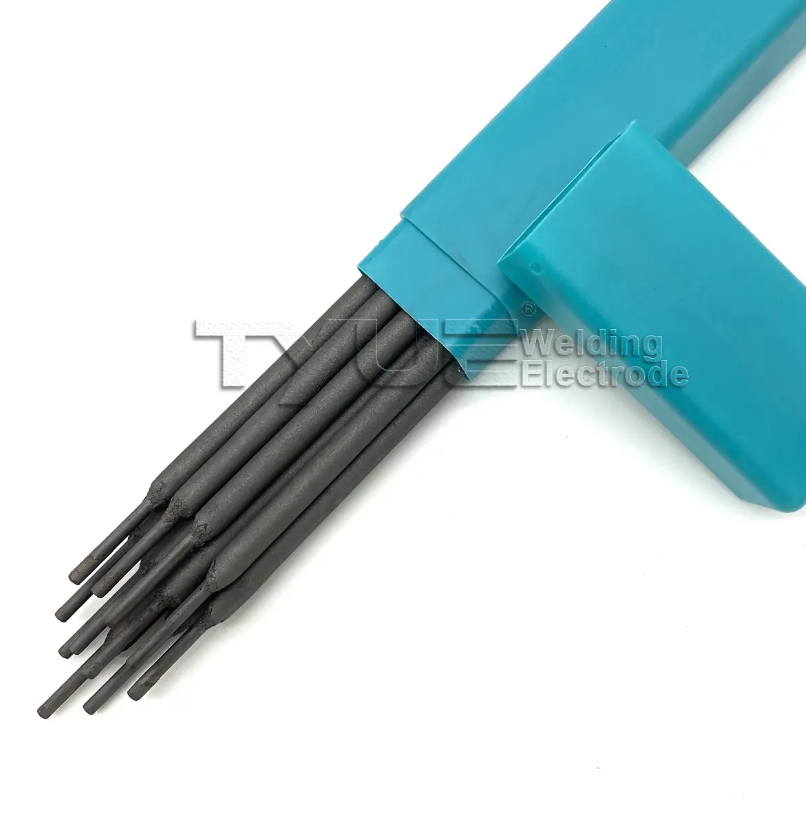
For those seeking a reliable, cost-effective option, TYUE’s AW DURMATIC (H-10) Hardfacing Welding Electrode stands out. This surfacing welding rod delivers a hardness of 58-63 HRC, making it ideal for crusher hammer repair and mining equipment hardfacing. It offers stable arc ignition, low spatter, and easy slag removal—perfect for both on-site and workshop repairs. Its wear-resistant alloy deposit ensures long service life, reducing maintenance frequency and operational costs.
Final Tips for Successful Hardfacing Repairs
Even with the best hardfacing rod, proper welding technique is key to a durable repair. Always clean the repair area thoroughly to remove dirt, rust, and oil. For high-carbon or alloy steel parts, follow preheating and post-weld cooling guidelines to prevent cracking. Match the rod diameter to the thickness of the component—3.2mm to 4.0mm rods are common for crusher hammer repairs.
By focusing on wear resistance, compatibility, and quality, you’ll select a hardfacing rod that extends the life of your mining equipment and crusher hammers. Whether you choose a well-established brand or a reliable option like TYUE’s AW DURMATIC (H-10), prioritizing the right Welding Stick ensures your repairs stand up to the rigors of mining operations.
Post time: Dec-30-2025