
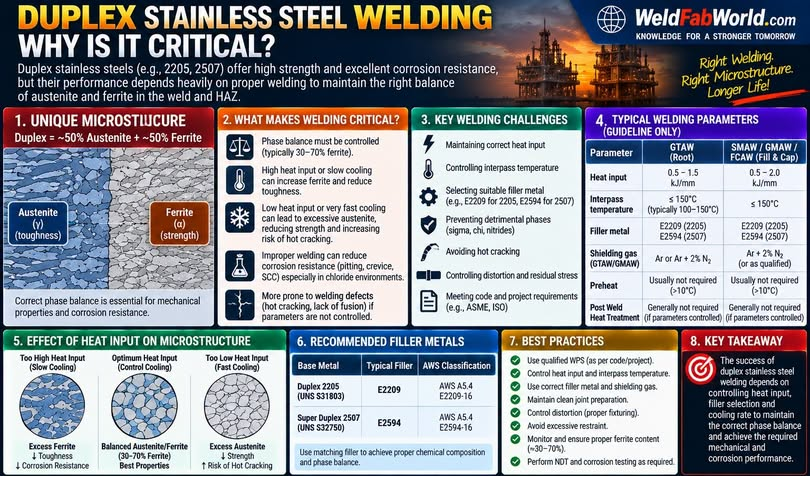
Duplex stainless steel gets its unique combination of strength, toughness and corrosion resistance from its two-phase microstructure: austenite + ferrite. Welding changes the thermal balance, so controlling the welding procedure is essential to preserve the required properties.
1. PHASE BALANCE MATTERS
The weld and HAZ need an appropriate austenite–ferrite balance.
Too much ferrite can affect toughness and corrosion performance, while excessive austenite can reduce the desired strength and corrosion characteristics.
2. HEAT INPUT IS CRITICAL
Too much heat → slower cooling → excessive ferrite/phase changes
Too little heat → rapid cooling → insufficient austenite formation
The actual acceptable heat-input range must come from the qualified WPS and applicable requirements.
3. FILLER METAL SELECTION
Typical matching fillers include:
Duplex 2205 → E2209
Super Duplex 2507 → E2594
The selected filler must provide the required chemistry, mechanical properties and corrosion performance.
4. INTERPASS TEMPERATURE & COOLING
Control of interpass temperature and the overall thermal cycle helps prevent undesirable phase changes and excessive precipitation of detrimental phases.
5. WHAT CAN GO WRONG?
Poor welding control can contribute to:
• Incorrect phase balance
• Reduced corrosion resistance
• Reduced toughness
• Hot cracking or other weld defects
• Distortion and residual stress
• Undesirable intermetallic-phase precipitation
KEY LESSON
Duplex welding is not simply about making a sound-looking weld.
You must control:
Filler → Heat Input → Interpass Temperature → Cooling → Phase Balance → Inspection
Remember: The exact limits depend on the grade, thickness, welding process, joint design, qualified WPS and applicable code/specification.
Post time: Oct-23-2026