
5 Critical Welding & Metallurgy Topics — Mechanical QA/QC
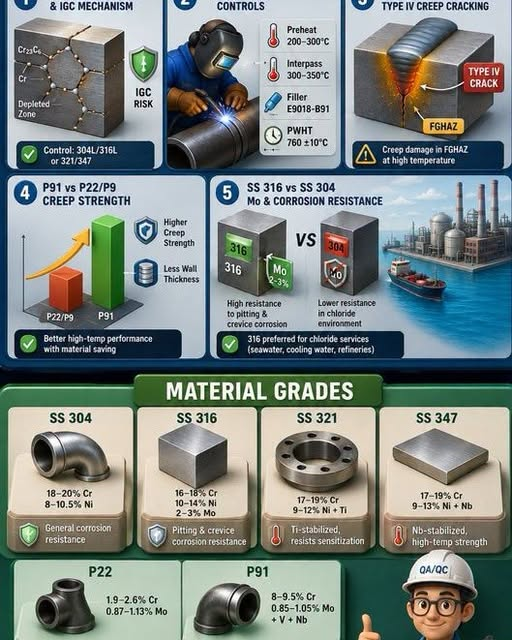
1. Austenitic SS — Sensitization & IGC Mechanism:
Exposure to approximately 500–800°C promotes Cr₂₃C₆ chromium-carbide precipitation at grain boundaries. This produces a Cr-depleted zone adjacent to the grain boundary, reducing passive-film stability.
Result: increased susceptibility to Intergranular Corrosion (IGC).
Control: Low-carbon grades 304L/316L or stabilized grades 321/347.
2. P91 Welding — Essential Metallurgical Controls:
Preheat: 200–300°C Interpass: 300–350°C
Filler: E9018-B91 PWHT: 760 ± 10°C Strict thermal-cycle control is essential to achieve the required tempered-martensitic microstructure and creep strength. Over-tempering can adversely affect high-temperature properties.
3. P91 Weldment — Type IV
Creep Cracking :- Type IV cracking develops predominantly in the Fine-Grained HAZ (FGHAZ). It is associated with long-term creep deformation under elevated-temperature service. The FGHAZ (Fine-Grained Heat-Affected Zone) has comparatively reduced creep strength, making it a critical location for creep rupture/failure in P91 weldments.
4. P91 vs P22/P9 — Creep Strength Advantage:
P91 is a 9Cr-1Mo-V-Nb creep-resistant steel with strengthening from Nb/V precipitation mechanisms. Higher creep-rupture strength permits reduced design wall thickness for comparable service conditions. This can reduce material consumption while maintaining high-temperature pressure-boundary integrity.
5. SS 316 vs SS 304
Mo & Localized Corrosion Resistance :SS 316 contains approximately 2–3% Mo, absent at this level in SS 304. Mo significantly improves resistance to chloride-induced pitting and crevice corrosion. Therefore, 316 is preferred for aggressive chloride-containing services such as seawater and refinery cooling-water systems.
Most Important Material Grades — Composition & Properties SS 304 → 18–20% Cr, 8–10.5% Ni | Excellent general corrosion resistance; good weldability.
SS 316 → 16–18% Cr, 10–14% Ni, 2–3% Mo | Superior pitting & crevice corrosion resistance, especially in chloride service. SS 321 → 17–19% Cr, 9–12% Ni + Ti | Ti-stabilized; excellent resistance to sensitization and suitable for high-temperature service.
SS 347 → 17–19% Cr, 9–13% Ni + Nb | Nb-stabilized; good high-temperature strength and resistance to sensitization. P22 → 1.9–2.6% Cr, 0.87–1.13% Mo | High creep strength and oxidation resistance; widely used in high-temperature piping. P91 → 8–9.5% Cr, 0.85–1.05% Mo + V + Nb | Superior creep-rupture strength; used for high-temperature pressure-boundary applications.
Post time: Aug-26-2026