
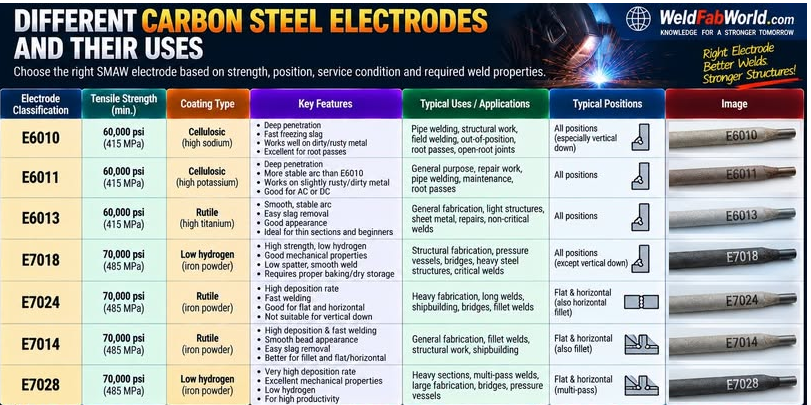
Different carbon-steel electrodes are designed for different combinations of penetration, strength, welding position, deposition rate, arc characteristics and service requirements.
♦ COMMON SMAW ELECTRODES
♠ E6010 — Deep Penetration
• Cellulosic coating
• Excellent for root passes
• All-position welding
• Common in pipe and field welding
♠ E6011 — Versatile Cellulosic
• Deep penetration
• Suitable for AC or DC
• Good for repair, maintenance and pipe welding
• All-position capability
♠ E6013 — Easy Arc & Good Appearance
• Rutile coating
• Smooth, stable arc
• Easy slag removal
• Common for light fabrication and sheet metal
♠ E7018 — Low-Hydrogen Electrode
• 70 ksi minimum tensile strength
• Excellent mechanical properties
• Used for structural, pressure-vessel and critical fabrication
• Requires proper storage and moisture control
♠ E7014 — Easy, High-Deposition Welding
• Rutile + iron powder
• Smooth bead appearance
• Useful for fillet and flat-position welding
♠ E7024 — High Deposition Rate
• Iron-powder rutile electrode
• Excellent for long welds
• Common in heavy fabrication and fillet welds
• Primarily flat/horizontal applications
♠ E7028 — High-Deposition Low-Hydrogen
• Low-hydrogen coating with iron powder
• High deposition rate
• Suitable for heavy sections and multi-pass fabrication
• Mainly flat/horizontal welding
♦ EASY MEMORY
E6010 → Deep penetration / pipe root
E6011 → AC/DC versatility
E6013 → Easy general-purpose welding
E7018 → Low hydrogen / critical fabrication
E7014 → Easy high deposition
E7024 → High deposition / flat & horizontal
E7028 → Low hydrogen + high deposition
♦ Important: Electrode selection should always follow the qualified WPS, applicable code, material requirements, welding position, polarity and service conditions. Electrode storage and manufacturer recommendations are especially important for low-hydrogen electrodes.
• Which electrode do you use most often: E6010, E6013, E7018, E7024 or E7028?
Post time: Sep-21-2026