
Preheating is not just about applying heat before welding.
It is a critical metallurgical control that directly impacts weld integrity, hydrogen control, and residual stress management.
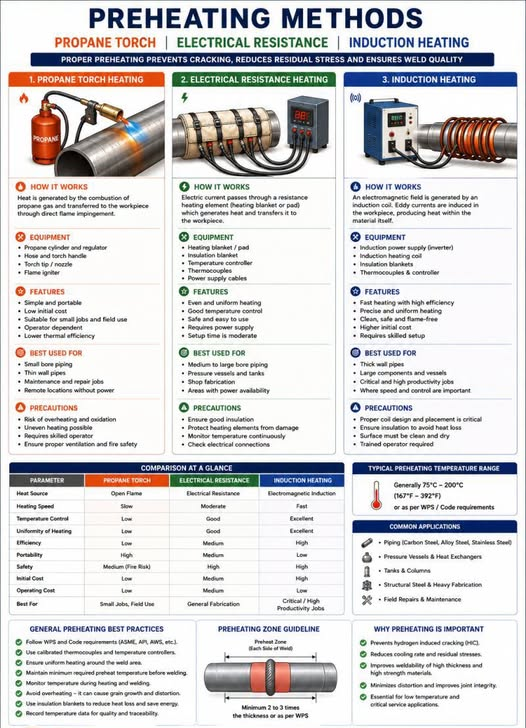
Below is the widely used preheating methods:
1 Propane Torch Heating
Simple, portable, and commonly used in field jobs.
√ Low setup cost
√ Easy to deploy
√ Suitable for small bore and repair work
But:
!Temperature uniformity can be poor
!Higher risk of overheating or oxidation
!Operator skill heavily influences results
2 Electrical Resistance Heating
A balanced method for controlled and uniform heating.
√ Better temperature distribution
√ Good control with thermocouples
√ Suitable for shop fabrication and vessels
Best for medium to large-scale fabrication where power is available.
3 Induction Heating
The most advanced and efficient method.
√ Fast heating rates
√ Excellent temperature control
√ Uniform heat distribution
√ Ideal for critical welds and thick sections
Widely used for:
• PWHT
• Heavy wall piping
• Pressure vessels
• High alloy materials
Why Preheating matters:
√ Reduces cooling rate
√Minimizes hydrogen cracking
√ Lowers residual stress
√ Improves weldability
√ Prevents hard microstructures in HAZ
√ Enhances weld quality and toughness
Key takeaway:
Not every job needs the most expensive method.
But every job needs the right method.
Selection depends on:
→ Material type
→ Thickness
→ Code requirements
→ Site conditions
→ Productivity targets
→ Heat control accuracy required
In welding, heat control is not a secondary activity.
It is part of quality assurance.
Which preheating method do you prefer in your projects — Torch, Resistance, or Induction?
Post time: Jul-31-2026