
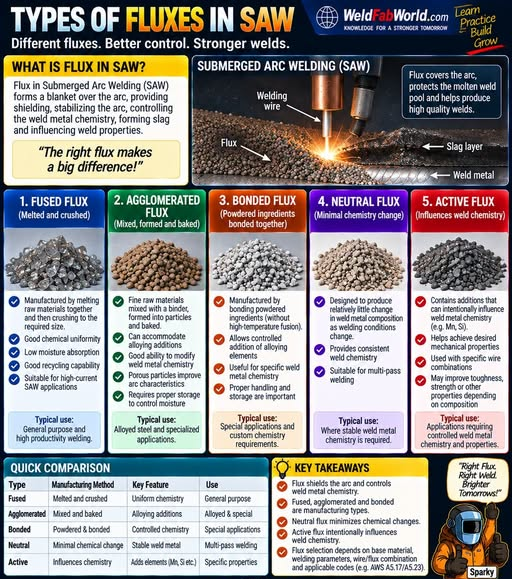
In Submerged Arc Welding (SAW), flux covers the arc and molten weld pool, providing shielding while also influencing arc stability, slag formation, weld-metal chemistry and mechanical properties.
1 . FUSED FLUX
Melted → cooled → crushed
• Good chemical uniformity
• Generally low moisture absorption
• Suitable for high-productivity welding
2 . AGGLOMERATED FLUX
Mixed → formed → baked
• Allows alloying additions
• Can influence weld-metal chemistry
• Proper storage is important for moisture control
BONDED FLUX
3 . Powdered ingredients → bonded together
• Useful for controlled weld-metal chemistry
• Can accommodate special alloying additions
• Used for specific applications
4 . NEUTRAL FLUX
Designed to cause relatively little change in weld-metal chemistry as welding conditions vary.
➡️ Commonly useful for multi-pass welding where consistent chemistry is important.
5 . ACTIVE FLUX
Contains additions that can intentionally influence weld-metal chemistry, such as Mn or Si.
➡️ Used where controlled changes in weld-metal properties are required.
♦ EASY MEMORY
Fused → Melted & crushed
Agglomerated → Mixed & baked
Bonded → Powder bonded
Neutral → Minimal chemistry change
Active → Influences chemistry
• Important: “Fused/agglomerated/bonded” describe manufacturing methods, while “neutral/active” describe weld-metal chemistry behavior. They are not simply five mutually exclusive manufacturing categories.
Always select the flux + wire combination according to the base material, welding parameters, required properties, qualified WPS and applicable specification.
Post time: Sep-24-2026