
Can you identify the welding technique just by looking at the bead pattern—and explain WHY the welder used it?
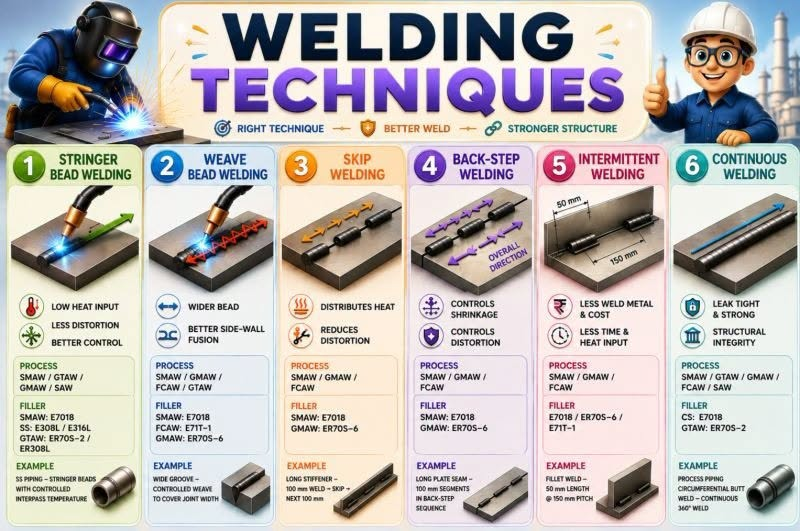
1. Stringer Bead Welding Technique: Straight bead, minimum/no transverse weaving.
»Why: ↓ Heat input, distortion & sensitization risk; better control.
»Process: SMAW / GTAW / GMAW / SAW.
»Typical filler: SMAW E7018; SS → E308L/E316L; GTAW → ER70S-2 / ER308L.
»Example: SS piping → stringer beads with controlled interpass temperature.
2. Weave Bead Welding Technique: Electrode/torch moves transversely across the joint.
»Why: Wider bead + better side-wall coverage/fusion.
»Process: SMAW / GMAW / FCAW / GTAW.
»Typical filler: SMAW E7018; FCAW → E71T-1; GMAW → ER70S-6.
»Example: Wide groove → controlled weave to cover joint width.
3. Skip Welding Technique: Weld short sections with temporary gaps between them.
» Why: Distributes heat → reduces distortion/shrinkage.
» Process: Mainly SMAW / GMAW / FCAW. Typical filler: SMAW E7018; GMAW → ER70S-6.
» Example: Long structural stiffener → 100 mm weld → skip → next 100 mm.
4. Back-Step Welding Technique: Overall weld progresses forward, but each short segment is deposited backward.
» Why: Controls longitudinal shrinkage and distortion.
» Process: SMAW / GMAW / FCAW.
» Typical filler: SMAW E7018; GMAW → ER70S-6.
» Example: Long plate seam → 100 mm segments welded in back-step sequence.
5. Intermittent Welding Technique: Separate weld segments with specified length & pitch.
» Why: ↓ Weld metal, heat input, fabrication time & cost. Process: SMAW / GMAW / FCAW.
» Typical filler: E7018 / ER70S-6 / E71T-1.
» Example: Structural fillet weld → 50 mm length @ 150 mm pitch.
6. Continuous Welding Technique: Weld deposited continuously over the specified joint length.
» Why: Required for pressure boundary, structural continuity or leak-tightness.
» Process: SMAW / GTAW / GMAW / FCAW / SAW.
» Typical filler: Depends on material/WPS; CS → E7018, GTAW → ER70S-2.
» Example: Process piping circumferential butt weld → continuous 360° weld.
Welding technique is not just about depositing metal—it controls heat input, fusion, distortion, shrinkage and final weld quality.
Post time: Aug-13-2026