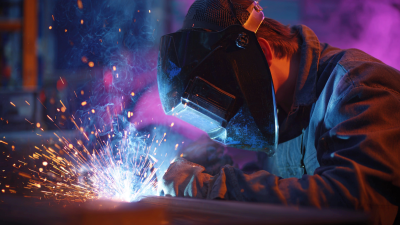
Welding is all about joining metals together with a strong, lasting bond, but the arc itself is just one piece of the puzzle. Duane K. Miller, a well-known welding engineer, has made a name for himself with his work on structural welding. According to the American Welding Society, welding is defined as "a materials joining process that creates coalescence of materials"—whether that’s through heat, pressure, or a combination of both, with or without adding filler metal. That’s a pretty precise description. Now, in a real-world workshop, things can get messier: factors like surface condition, how well the parts fit together, and the skill of the welder can all influence how the final joint turns out.
When it comes to different types of welding, each one has its own heat sources and techniques. For example, shielded metal arc welding uses a coated, consumable electrode—it’s pretty much a staple on construction sites. Then there’s gas metal arc welding, which feeds wire through a gun, making it great for consistent, high-volume work. Gas tungsten arc welding, on the other hand, gives you very fine control—perfect for thinner materials or getting those clean, detailed joints. Flux-cored arc welding uses a tubular wire, while submerged arc welding keeps the arc hidden beneath a layer of granular flux—each method has its pros and cons, and honestly, there’s no one-size-fits-all best option.
A shiny bead that looks perfect can be tempting to get excited about, but let’s be real—looks aren’t everything. The actual design of the joint, how thick the materials are, how easy it is to access the weld area, and proper inspection all matter big time. Sometimes, even seasoned pros can miss tiny flaws, so it’s worth paying close attention to process checks. This guide breaks down what welding really means, how the main methods differ, and where each one works best. It also clearly states what a process can’t guarantee—no matter which method you use, proper prep and skilled execution are absolutely essential.
Welding joins materials by forming a bond at their meeting surfaces, most often between metal parts. In fusion welding, heat melts the edges and sometimes a filler metal, creating a small pool of liquid material. That pool cools and solidifies into a joint. No glue is involved. Other methods use pressure, motion, or both to bond materials without fully melting them.
Different processes supply energy in different ways. Arc welding uses an electric arc to generate heat, while resistance welding heats metal where parts press together. Gas welding uses a flame. In solid-state welding, pressure and movement help bring clean surfaces into close contact. The method chosen depends on the material, its thickness, the joint’s shape, and how the finished part will be used. There is no single process that suits every job.
Preparation matters as much as the heat source. Oil, rust, or paint can interfere with bonding, so surfaces are usually cleaned before work begins. Parts must also fit closely; even a small gap can change how the joint forms. Welders may tack parts in place, then work along the seam while managing heat and distortion. The textbook explanation sounds tidy. Real joints are less predictable. A smooth-looking bead does not prove the bond is sound, so trained inspection may include visual checks and suitable tests.
Welding joins materials by applying controlled heat, pressure, or both. The heat melts the edges, creating a small pool of liquid metal. As this pool cools, it forms a permanent joint. Some processes use a separate filler metal. Others join the surfaces directly. Shielding gas or flux protects the hot metal from oxygen and contamination. Without protection, the weld may become weak, porous, or brittle.
Arc welding uses an electrical arc between an electrode and the workpiece. MIG welding feeds a continuous wire through a torch. TIG welding uses a non-consumable tungsten electrode and offers careful control. Resistance welding creates heat through electrical resistance and pressure. Each method suits different materials, thicknesses, and production conditions.
In practical work, joint preparation matters greatly. A dirty edge can ruin an otherwise skilled weld. I have found that many beginners focus on the torch, but overlook fit-up and clamping. That mistake is easy to repeat.
Tips: Clean the surfaces before welding. Keep the torch angle steady. Watch the weld pool, not only the bright arc. Use suitable protective equipment, ventilation, and eye protection. Check the finished joint for cracks, undercut, uneven width, or trapped holes. A visual inspection cannot reveal everything. Critical structures may require additional testing by trained professionals. Settings printed in a manual are useful, but real metal thickness and position may demand adjustment.
Welding joins metals or thermoplastics through heat, pressure, or both. In practical work, the joint design matters as much as the welding machine. A narrow groove, clean surface, and correct fit-up can prevent costly defects.
Shielded Metal Arc Welding, or SMAW, uses a flux-coated electrode. It works well outdoors and on thick steel, but slag removal slows production.
Gas Metal Arc Welding, known as GMAW, feeds a continuous wire and supports fast, clean work. It suits workshops, yet wind can disturb its shielding gas.
Gas Tungsten Arc Welding produces precise, attractive seams on thin materials. It demands steady hand control and patience.
Flux-Cored Arc Welding offers strong deposition rates and performs better outdoors than gas-shielded processes.
Submerged Arc Welding is highly productive for long, straight seams, especially on heavy plate.
Method selection should follow material, thickness, position, and site conditions. The American Welding Society’s workforce research has warned of a potential shortage exceeding 300,000 welding professionals in the coming years. Training quality therefore matters, not just equipment access.
In my view, charts often make process selection look simple. Real joints are less cooperative. Moisture, rust, awkward angles, and operator fatigue can change the result. A qualified welder still needs procedure control, inspection records, and suitable ventilation around welding fumes.
Welding joins metals by creating a controlled heat source. The process changes sharply with heat intensity, shielding, and equipment.
In shielded metal arc welding, a coated electrode produces the arc and shielding gas. It suits outdoor repairs, but slag removal slows production.
Gas metal arc welding uses a continuously fed wire, a power source, and external shielding gas. It works quickly on clean steel, though wind can disturb the gas shield.
Gas tungsten arc welding uses a non-consumable tungsten electrode. Its focused arc gives excellent control on thin stainless steel or aluminum. However, it demands steady hand movement and usually takes longer.
Flux-cored arc welding can provide deeper penetration and better outdoor performance.
Equipment choice is rarely simple. Welding current, travel speed, joint design, and material thickness all change heat input. The AWS Welding Handbook describes heat input as closely linked to voltage, amperage, travel speed, and arc efficiency. Small errors can cause distortion or incomplete fusion.
Tips: Check the material data sheet before selecting a process. Use a calibrated machine and record voltage, current, and travel speed. OSHA identifies welding fumes as a serious workplace exposure, so local exhaust ventilation and suitable respiratory controls matter. The U.S. Bureau of Labor Statistics projects about 42,600 annual openings for welders, cutters, solderers, and brazers from 2023 to 2033. Training remains valuable, but classroom knowledge alone is not enough. Real joints can behave unpredictably. Inspect the bead, question the settings, and improve the procedure.
What Is Welding and What Are Its Main Types?
Materials Commonly Used in Welding
Welding joins materials through heat, pressure, or both. Arc, gas, resistance, and solid-state methods suit different metals and joint designs. Carbon steel remains a common choice because it is strong, affordable, and widely available. The World Steel Association reported approximately 1.89 billion tonnes of crude steel production in 2023. That scale supports a deep supply chain for plates, pipes, rods, and filler wires.
Stainless steel resists corrosion, but excessive heat can reduce its performance. Aluminum is lightweight and conducts heat quickly, demanding careful control of travel speed and shielding. The International Aluminium Institute recorded more than 70 million tonnes of primary aluminum production in 2023. Copper conducts electricity extremely well, yet that same property pulls heat away from the weld zone. Nickel alloys handle severe heat and chemical exposure. Titanium is lighter, but contamination can ruin a joint.
Filler metals must match the base material and service conditions. Shielding gases protect molten metal from oxygen and moisture. Flux helps remove oxides and stabilizes certain welding processes. Flux matters too. A practical shop lesson is simple: clean edges improve results. However, clean metal does not guarantee a reliable weld. Fit-up, joint design, storage, and operator technique still matter. A bead can look smooth while hiding porosity or incomplete penetration. That uncomfortable detail is why qualified procedures and inspection remain essential. The best material choice balances strength, corrosion resistance, heat control, and repairability—not just appearance.
Welding joins materials by applying heat, pressure, or both to create a permanent bond. The chart compares representative melting points of commonly welded metals. Carbon steel and stainless steel melt across temperature ranges, so the values shown are approximate midpoints.
Welding joins metals by melting their edges or adding a separate filler metal. Common methods include arc welding, gas welding, resistance welding, and laser welding. Each process creates different heat levels, penetration patterns, and surface finishes. The right choice depends on material thickness, joint design, production speed, and working conditions.
Construction crews use welding to connect steel beams, bridge components, pipelines, and protective railings. In vehicle manufacturing, robotic arc welding joins frames and suspension parts with consistent heat control. Shipyards weld thick plates under demanding conditions, where distortion and corrosion require careful planning. Energy facilities also depend on certified welders for tanks, pressure systems, and structural supports. These applications need qualified procedures, clean surfaces, and inspections such as visual, ultrasonic, or radiographic testing. Small defects can become serious failures.
Welding also supports agricultural equipment, medical structures, repair workshops, and custom metalwork. Resistance welding suits high-volume sheet-metal production, while laser welding offers narrow, precise joints for delicate components. Field repairs are less predictable. Wind, moisture, poor access, and worn equipment can reduce weld quality. A strong-looking bead may still hide internal weakness. That is why training, protective equipment, ventilation, and documented inspections matter. Welding is powerful, but it is not forgiving. Teams should review failed joints honestly, because repeated habits can conceal preventable mistakes.
| Welding Process | How It Works | Common Materials | Key Applications Across Industries | Main Strengths | Important Considerations |
|---|---|---|---|---|---|
|
Shielded Metal Arc Welding (SMAW) Also called stick welding |
An electric arc melts a flux-coated consumable electrode and the base metal. The flux forms shielding gases and slag as the weld is made. | Carbon steel, low-alloy steel, and some stainless steels | Construction, structural steelwork, pipeline repair, ship maintenance, and field repairs | Portable equipment; suitable for outdoor work and many repair situations | Electrodes must be changed as they are consumed, and slag usually needs to be removed between passes. |
|
Gas Metal Arc Welding (GMAW) Often called MIG or MAG welding |
A continuously fed wire electrode melts into the joint while an external shielding gas protects the weld area. | Carbon steel, stainless steel, and aluminum, with suitable wire and shielding gas | Automotive manufacturing, metal fabrication, machinery production, and general manufacturing | High productivity and continuous wire feeding make it well suited to repetitive work and automation. | External shielding gas can be disrupted by wind, so outdoor use may require protection from drafts. |
|
Gas Tungsten Arc Welding (GTAW) Often called TIG welding |
An arc from a non-consumable tungsten electrode melts the joint. Filler metal can be added separately when required, and shielding gas protects the weld. | Stainless steel, aluminum, nickel alloys, and other weldable metals | Aerospace components, food-processing equipment, pipework, and precision fabrication | Offers precise control and can produce clean welds on thin materials. | Typically slower than wire-fed processes and requires considerable operator skill. |
| Flux-Cored Arc Welding (FCAW) | A continuously fed tubular wire contains flux. Depending on the wire type, shielding may come from the flux alone or from flux together with an external gas. | Primarily carbon and low-alloy steels; some wires are designed for stainless steel. | Heavy fabrication, construction, shipbuilding, and structural steelwork | Can provide high deposition rates and is available in wire types suited to different work conditions. | Some variants produce slag and fumes; gas-shielded variants may be affected by wind. |
| Submerged Arc Welding (SAW) | An arc and continuously fed wire operate beneath a layer of granular flux, which shields the weld and helps form slag. | Commonly carbon steel and low-alloy steel; process suitability depends on the wire and flux combination. | Pressure vessels, large-diameter pipes, ship panels, and heavy plate fabrication | Well suited to long, repeatable welds and high production rates in mechanized or automated setups. | Most suitable for flat or horizontal work and accessible joints; the flux requires handling and recovery. |
| Resistance Spot Welding | Overlapping metal sheets are pressed between electrodes while electric current generates heat at the contact area, forming a localized weld. | Most commonly steel sheet; equipment and settings can also be designed for other conductive sheet metals. | Automotive body assembly, appliance manufacturing, and sheet-metal production | Fast, repeatable, and readily automated for joining overlapping sheets. | Requires access to both sides of the joint, and is generally used for lap joints rather than continuous seams. |
| Laser Beam Welding (LBW) | A focused laser beam supplies concentrated heat to fuse the joint, often with automated positioning and, where needed, shielding gas. | Materials and thicknesses depend on the laser system, joint design, and process setup; steel and aluminum are common examples. | Automotive components, electronics, medical-device manufacturing, and precision engineering | Can produce narrow welds with a small heat-affected zone and is suitable for high-speed automation. | Requires specialized equipment and careful joint alignment; reflective materials and gaps can affect process performance. |
DIN 8555 E7-UM-250-KPR is a basic-coated, high-recovery SMAW electrode designed for surfacing components exposed to impact and abrasive wear. Its fully austenitic weld-metal structure combines high toughness with pronounced work-hardening: the deposited layer can strengthen as it is subjected to service impact, while retaining the toughness needed to help resist cracking. These characteristics make the electrode suitable for rebuilding and protective surfacing of parts such as crusher components, conveyor equipment, and other heavy-duty machinery. High recovery also supports efficient deposition during maintenance work, where reducing downtime and restoring worn surfaces are important operational priorities.
The value of such repairs is underscored by the scale of steel use in industrial equipment and infrastructure. The World Steel Association’s April 2024 Short Range Outlook forecast global steel demand to increase by 1.7% in 2024, illustrating the continuing demand for steel products and the assets that depend on them. For arc-welding applications, E7-UM-250-KPR offers a practical combination of weld-metal toughness, work-hardening capacity, and high deposition recovery. Correct procedure selection—including suitable current, electrode handling, and preparation of the base metal—helps achieve a sound surfacing deposit and dependable service performance.
Welding joins materials using controlled heat, pressure, motion, or a combination. Some methods melt the edges, while others bond clean surfaces without melting them. No glue is involved.
Heat melts the meeting edges and sometimes added filler metal. A small liquid pool forms. It cools into a solid joint.
Common methods include arc, resistance, gas, and solid-state welding. Arc welding uses an electrical arc. Resistance welding uses pressure and electrical resistance.
Oil, rust, paint, and moisture can weaken bonding. Clean edges help the weld pool form evenly. A dirty edge can ruin skilled work.
Thin sheet may need precise heat control. Thick plate may suit processes with higher deposition rates. Joint shape and welding position also matter.
Use suitable eye protection, protective clothing, ventilation, and equipment settings. Keep the work area clear. Fumes need careful control.
No. A smooth surface may hide cracks, trapped holes, or weak bonding. Visual inspection helps, but important joints may need trained testing.
Beginners may focus on the bright arc instead of the weld pool. They may overlook fit-up, clamping, or surface cleaning. I still find settings need adjustment in real conditions.
Excessive heat can distort parts or change the joint’s shape. Small gaps may alter penetration. Real joints are less predictable than diagrams suggest.
Welding is a manufacturing process that joins two or more materials, usually metals or thermoplastics, by applying heat, pressure, or a combination of both. The process creates a strong bond by melting the edges of the materials or using an additional filler material. As the heated area cools, it forms a permanent connection. The basic principles of Welding depend on controlling energy, temperature, timing, and the condition of the surfaces being joined.
Common welding methods include arc welding, gas welding, resistance welding, and beam-based processes. They differ in their heat sources, equipment, operating speed, precision, and suitability for specific materials or working environments. Metals such as steel, stainless steel, aluminum, and copper are frequently welded, while certain plastics can also be joined with specialized techniques. Welding is widely used in construction, transportation, manufacturing, shipbuilding, energy systems, repair work, and many other industries because it provides durable and efficient structural connections.